We get our names from our parents. When something new is discovered, it is
usually people who name the new object or event. Being in a technological era,
computers are used a lot of industries and in homes. As important as it is,
have you ever wondered where the word "computer" got its name? It is
actually quite interesting. In fact, if you think about it, the word
"computer" is very similar to the word "compute,"
which means to "to determine by calculation; calculate."
Let's start from an earlier time before computers ever came to be. There was
a man, Gottfried Wilhelm Leibnitz, who
developed logic into a binary system that we know of today; it was more of a
mathematical system than an English system. Like the Boolean, started by George
Boole, it is the same as something being true and something being false. The 1
represented true and the 0 represented false. This idea was used in real work
situations. For example, it was used in punch cards that workers used to sign
in and sign out of their work shift during the industrial revolution.
Soon after, before computers became electronic, computers
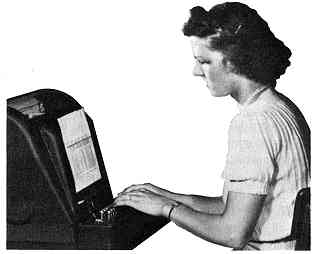
were actually clerks that performed computations. Many of these computers were
women at the time. Many of these women having a math degree, they worked in
different areas such as in government and in research facilities. More
mechanical devices were made, and computers were then known as computing
machines that did the job of a human computer. These computers performed much
faster than human computers. Throughout time, mechanical computers became were
the analog kind, then the digital kind, and now the computer architecture it is
today.
Computer programming and computer scientists could not have existed if there
were no computer to use in the first place. The computer, from human to
machine, is definitely an important part of computer science history.
Friday, November 15, 2013
Sunday, November 10, 2013
History of Computer Science: The Really Early Days
Have you ever seen something or heard something and thought to yourself: "I wonder how they made that" or "How did that ever get started?" I have. Looking at the current technology that we have available right now, I have wondered about a lot of things such as when the first computer was built, how the Internet became what it is, and how the computer language started. Being in the computer science field, how it all started has also crossed my mind.
Computer science is defined as "the scientific and practical approach to computation and its applications. It is the systematic study of the feasibility, structure, expression, and mechanization of the methodical processes (or algorithms) that underlie the acquisition, representation, processing, storage, communication of, and access to information."
When we study computer science, we deal with a lot of computations and algorithms. In fact, one of the origins of computer science were tools that were used to help in computations such as the abacus, which were used by the Sumerians. The mechanical analog computer was also a part of the revolutionary progress of computer science.
As mathematical computations increased, machines were built to help these computations; mechanical devices were built to help factor integers. As more theory and questions were asked, more and more devices were built to help figure out the answers such as the Turning machine.
Calculations needed for war helped give birth to one of the first electronic digital computers. With the help of IBM, the Mark I electromechanical computer helped calculate ballistics in World War II.
In the 1960's, computer science became its own field.The first computer science department was formed at Purdue University in 1962. Operating systems were also starting to become more advanced. Fred Brooks, at IBM, designed System/360, "a line of different computers with the same architecture and instruction set, from small machine to top-of-the-line." Edsger Dijkstra, at Eindhoven, designed the THE multiprogramming system. At the end of the decade, ARPAnet, a precursor to today's Internet, began to be constructed.
Starting from a simple device like the abacus to an electronic device like the digital computer, who would have thought that this would lead to the development of computer science.
Monday, November 4, 2013
File Sharing: Let Me Give You a Copy
I remember back in elementary school, having English as a second language, I learned a new word and concept: sharing. I kept some toy blocks to myself and I was told to share. I also had some crayons that belonged to the teacher's that I had to share. Being so young back then, I had always wondered why I had to share items with other people. I just could not understand why I couldn't have all of these things to myself. Of course, I have outgrown that phase, and I now share things with almost no hesitation. Sharing is basically dividing what you have and giving it to others; it can also mean giving another person a copy of what you have on the computer via online or storage such as a hard drive, or file sharing.
File sharing is "the practice of distributing or providing access to digitally stored information, such as computer programs, multimedia (audio, images and video), documents or electronic books." The ability to share has gone from sharing to the people around you to sharing to the world wide web. There are many ways to share files: hard drives, e-mail, and file sharing websites.
Sharing files is only a click away. If someone wanted to put a file online so others or himself can access on another device, then he can put it on file sharing websites. Some common websites used to share include MediaFire and DropBox. There are also peer-to-peer (P2P) file sharing programs such as LimeWire and Vuze. To define P2P, it "connects in to a peer-to-peer network to search for shared files on the computers of other users connected to the network." Lastly, there are also BitTorrent methods of sharing. Also known as torrents, this method uses the P2P file sharing method to share large files through the Internet. Many files can be downloaded from torrents such as programs, movies, and games.
Although there may be legal issues when downloading some files on the Internet, file sharing is practiced by everyone. It is a great way to send/receive copies of many different files. Everyone can get what they want and everyone can be selfish, though I'm not saying you should be selfish!
Tuesday, October 29, 2013
Data Structures: How it Works
Think about some of the furniture that we have in our living premises. The cabinets in the kitchen store cups and plates, the closet in our rooms stores clothing, and the garage, if you have one, stores vehicles. We put the objects we have into those different compartments because it is easy for us to organize and access them to get what we need. Like a computer, there ways to store and access data that allow us to do what we need to do. These storage are called data structures, which is a way of storing and organizing data in a computer so that it can be used efficiently.
Each data structure helps the programmer handle large amounts of data and structure them in a manageable way. Common uses of data structures, for example, are searching and sorting. Searching allows us to find the data we need in a structure and sorting allows us to organize the data. Having data structures can sometimes allows us to do less work. Some data structures include arrays, linked lists, and binary trees. They all have their own advantages and disadvantages: arrays are good for searching, but not adding data, linked lists are good for adding, but not searching data, and binary trees are good for both searching and adding data.
Basically, each data structures have their own sets of operations that are performed to access and change data. It is important to have knowledge of different data structures so we know which will be the most advantageous in our programs. Like our household furniture, it would be inconvenient to put our clothing inside kitchen cabinets and plates inside closets.
Tuesday, October 22, 2013
Hacking: Thank Goodness for Rebels
In life, there are always good and bad people. In a classroom, there are always those that follow all the rules and those that rebel and break the rules. Like the shoulder angels and devils, you know, where the angel tells you to do the right thing and the devil tells you to do the wrong thing, you can't have one without the other. In other words, you can't have good without bad; you can't have good hackers without the bad hackers. It is because of the good hackers that there are bad hackers and the other way around.
A hacker is defined as "a person who illegally gains access to and sometimes tampers with information in a computer system." We usually think of hackers as bad, but there are situations when hackers do bad for the greater good. You can compare it to Batman, where he does wrong things because good behavior and following the law isn't enough to accomplish what needs to be done.
People think of hacking as breaking into computers and stealing data and files. While there are hackers that do such things, known as the "Black Hats," there are other hackers that, for example, hack into sites in order to help improve them, known as the "White Hats." Hackers are talented coders, since they are able to do either good or bad to different sites and systems.
Without hackers, we wouldn't have some of the things we use almost everyday today. The desire to explore systems and see how they work made many hackers knowledgeable. Open-sourced programs wouldn't have much improvement without hackers. Steven Jobs built Apple. Mark Zuckerberg founded Facebook. Linus Torvalds created Linux.
Though it is important to not forget about the black hat hackers, if one can stand out and do something that benefits others as a white hat, then they are also hackers. Hacking, like Batman, whether it is good or bad, is up to you to decide.
A hacker is defined as "a person who illegally gains access to and sometimes tampers with information in a computer system." We usually think of hackers as bad, but there are situations when hackers do bad for the greater good. You can compare it to Batman, where he does wrong things because good behavior and following the law isn't enough to accomplish what needs to be done.
People think of hacking as breaking into computers and stealing data and files. While there are hackers that do such things, known as the "Black Hats," there are other hackers that, for example, hack into sites in order to help improve them, known as the "White Hats." Hackers are talented coders, since they are able to do either good or bad to different sites and systems.
Though it is important to not forget about the black hat hackers, if one can stand out and do something that benefits others as a white hat, then they are also hackers. Hacking, like Batman, whether it is good or bad, is up to you to decide.
Tuesday, October 8, 2013
Open Source: Free is Good
There are a lot of things that require money. If we wanted to make something, then we would have to buy the necessary tools. As a college student, I have to save as much money as possible whenever I can so I don't have a lot of debt. The average college student uses the computer almost everyday. They also have to use programs that cost a lot of money such as Microsoft Office and Adobe Photoshop. There are also alternatives to these program that are not just free, but you can also learn from it, alter it, and share it such as LibreOffice and GNU Image Manipulation Program. These types of programs are called "open source" programs.
Open source, by definition, is "a development model promotes universal access via free license to a product's design or blueprint, and universal redistribution of that design or blueprint, including subsequent improvements to it by anyone." It's basically a computer program that has its source code available to the general public that is useable and modifiable.
It's good to have these open source programs because, of course, it's free, and also because many other programmers can modify the code and send it to the creator, which drastically improves the program. It is the same as volunteering to do good in some way to benefit the community.
You don't have to be a programmer to be able to use these open source programs. The more people that use these programs, the better because it allows the developers to know that people actually use the program, other programmers will try to improve it, and it allows others with money issues to do their work.
Open source programs sound too good to be true. Don't worry. It's true.
Wednesday, October 2, 2013
Agile: A Different Way to Manage Teams and Projects
term for the many different methods available is agile.
You might have heard of different agile methods such as Unified Process, Scrum, and Dynamic Systems Development Method. Back in the day, people got tired of the failing traditional method of managing development projects, so some of those people got together and came up with four important values, known as the agile manifesto:
2) Working software over comprehensive documentation
3) Customer collaboration over contract negotiation
4) Responding to change over following a plan
As they said, in short, "While there is value on the right side, we just value the left side more."
Some of the common key principles of agile include teams have the power to make decisions, requirements change but the time is fixed, and collaboration between the manufacturer and team members is important.
The business world changes as well as the technology. Agile methods tell us to make use of what is available to us, use your time wisely, and start adjusting to the modern world, not the stone age.
Subscribe to:
Posts (Atom)